Posts
All Comments
Posts
All Comments


Frank Gehry was born in Toronto in 1929 as Ephraim Owen Goldberg. His father was a travelling salesman selling jukeboxes, pinball machines, and slot machines. Sometimes as a child he would make sales calls with his father, but his mother made an effort to balance out all the time spent in bars by taking him to art museums and concerts as well. He also spent time in his grandfather’s hardware store, building imaginary cities out of scraps of wood. After the war ended in 1945, the Canadian government began more strictly enforcing gambling laws, and his father’s business suffered. When some bad investments wiped out most of the family’s savings and his father had a heart attack, they decided to leave Ontario and make a new start.
In 1947, when Frank was 18, they moved to Los Angeles, where Frank worked as a truck driver to earn his way through college taking night classes. He married his first wife, Anita Snyder, in 1952. The two would remain married for sixteen years, during which they had two daughters. It was she who convinced him to change his name to Gehry, concerned that their daughters would be bullied or ostracised for being Jewish. Later in life, he mentions changing his name as the one decision in his life that he regrets.
With his wife’s financial help, he finished college and graduated the USC School of Architecture in 1954. After graduation, he served a brief stint in the Special Services division of the army, making furniture for the enlisted soldiers, though the quality of his work was such that the things he made usually ended up in the officers’ quarters. When he left the army, he spent a year studying urban planning at Harvard, but dropped out without getting his degree and found work at Gruen Associates, an architectural firm specializing in the Modernist style: simple, functional, and unornamented.
In 1961, he and his family moved to Paris. They lived there for a year, with Frank working for a French architect named Andre Remondet and making weekend trips to cathedrals and other sites of famous architecture. Then they relocated back to California in 1962, where he established his own design firm and began his independent career as an architect. As well as traditional architectural commissions, he designed a line of furniture that was the first of his works to gain more widespread notice. In a true break from his earlier employer, his furniture is considered as much artwork as furnishing. Drawing on natural shapes, his “Easy Edges” and “Rough Edges” collections are made of curving folds of thin, laminated wood and cardboard.
During the 60’s and 70’s he worked on the designs for many buildings, including the Concord Pavillion, but it was not until 1977 that he became truly famous—or infamous—for his eccentric and imaginative rebuilding of his own house. Originally an ordinary 2-story suburban home, he transformed the little pink house into a fantastic industrial monstrosity, exposing pipes and beams, using materials such as cement, chain-link fencing, plywood, and corrugated steel.
This began the period of his work that he is best known for: deconstructed, industrial, and raw. In many ways, and to his frustration, this is the style of building that still defines him today to many admirers. He’s been hailed as “the apostle of chain-link fencing and corrugated metal siding.” “Personally, I hate chain-link,” he admitted once in an interview. “I was playing with a denial mechanism in the culture. Rich people hate chain-link and yet they put it around their tennis courts. Then they don't see it. Psychologically, it's not there for them. I was saying, 'Since it is there, why not make use of it?'"
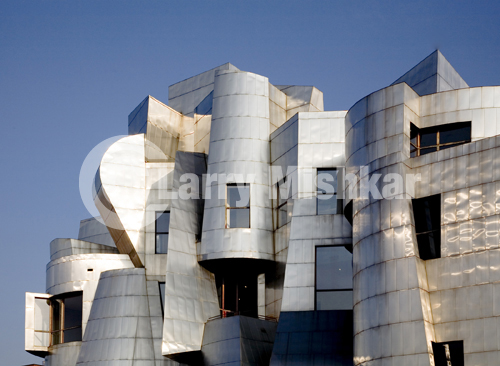
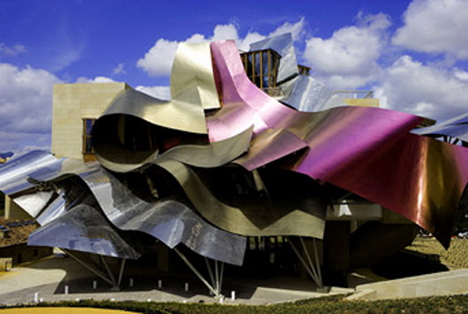
With the rise of his reputation, his firm became increasingly popular and during the subsequent years he designed many buildings that have become landmarks and tourist attractions in themselves. He uses computer simulations extensively to model his designs, which use organic, broken, and distorted shapes and often resemble sculpture more than they do architecture. However despite this and his tendency to identify himself more as an artist than an architect, there is a solid practicality behind the bizarre forms of his creations. His firm has a reputation for always finishing buildings on time and within budget, which is even more impressive considering the complexity and unusual requirements of his designs. He also builds with function in mind; for instance, the Disney Concert Hall in Los Angeles that he designed has superior acoustics. A musician can be placed anywhere in the hall and his music will be heard with equal clarity, making it possible to perform a vast range of pieces which would not work effectively in most theaters.
In 1989, Frank Gehry received the Pritzker Prize for Architecture, the highest honor an architect can be awarded. Even today, at age 71, he continues to design masterpieces and explore new concepts.

the Casa Batllo designed by Antonio Gaudi.
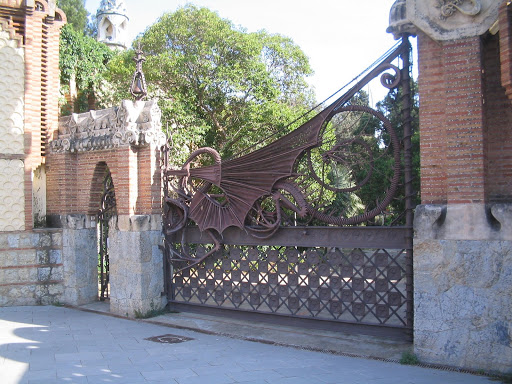 The Dragon Gate at Parc Guell, Barcelona, also by Gaudi
 .Le Palais Ideal in France, designed and built by Ferdinand Cheval
 Another shot of Le Palais Ideal
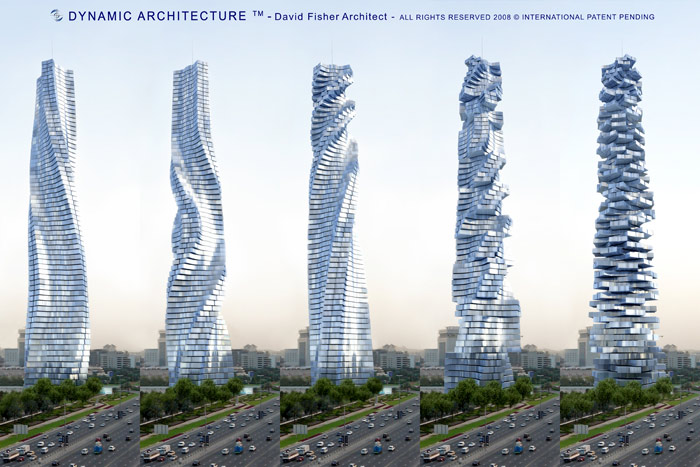 The Rotating Tower in Dubai, designed by Dr. David Fisher, scheduled to be completed this year.
 Mind House in Barcelona (can't find out who designed)
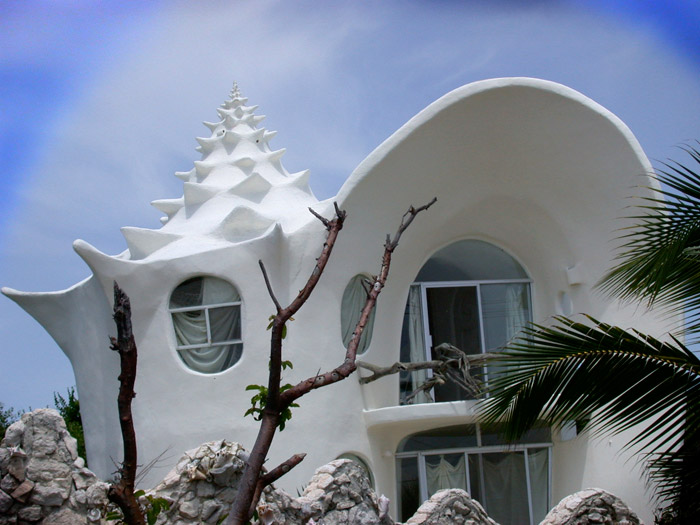 Conch Shell House, Mexico, by Octavio Ocampo